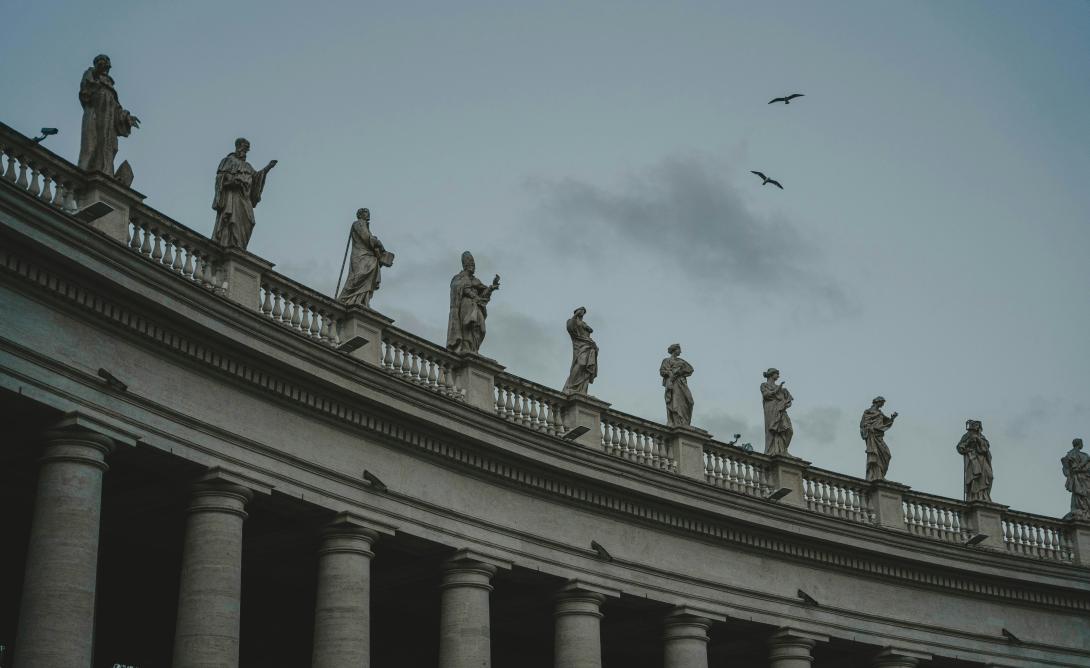
The news of Pope Francis's death just after Easter 2025 has prompted a wave of reflection. I see this wave, not only across the Catholic world but within my own winding journey through faith, family, and the search for meaning. As the cardinals gather in Rome for the secretive conclave, watched by tens of thousands in St Peter's Square and millions around the globe, I find myself thinking back to the threads of religion that have run through my life, sometimes tightly woven, sometimes loose and frayed.
Baptism, Belonging, and Belief
Officially, I am a Catholic. I've been baptised twice, first in the hurried, anxious hours before life saving surgery as a newborn to correct pyloric stenosis, then again in a more formal family setting. My grandmother, "Nanny Slim," and my mother were the architects of these rites, their faith a gift and a shield. Yet, even as a child many years later, at St John's Independent School in Newton, Nottage near Porthcawl, clad in a brown blazer and singing in the church choir, I sensed that belief was not something to be inherited or performed, but discovered and wrestled with.
I proudly read passages and Psalms from the Bible to the congregation before the vicar’s sermon, attended services most Sundays (unless I was off adventuring in mid-Wales) but never felt right pursuing confirmation or communion without genuine conviction. The vicar, whoever they were at the time (they changed a few times during my years there), respected my honesty about being agnostic or perhaps atheist, and encouraged my questions rather than demanding answers. I recall when one of the vicars left for another parish, he wrote heartfelt leaving cards to all the boarders of St John's as a group. I received an individual card, addressed only to me. In it he wrote that he hoped I would "find my true path." I still keep that card; it touched me deeply.
Even in those Sunday services, when we would line up pew by pew to receive communion, my "blessing" was often a cross drawn on my forehead with the vicar's thumb, followed by a knowing flick and a grin that always made me smile.
Family, Identity, and the Laughter of Labels
Years later, my confusion over religious labels became a family joke. I once told my future wife, by accident, that I was Christian. Only to be "outed" as Catholic by my youngest brother (eight years my elder) after his trip to Rome, where he'd seen the Pope himself on a balcony during an IT training trip. He was excitedly showing me photos on his iPad, going on a bit longer than if it had been just any celebrity. When I asked why he thought I'd be so interested, he replied, much to my and my fiancée's shock: "Because you're Catholic!"
My fiancée laughed loudly and called me a liar, while my brother and his wife couldn't believe I thought I was "Christian." Especially after attending a church with Latin mass and all the pomp and ceremony throughout my childhood, I had lost over time, the actual idea there was a distinction. We still laugh about this today. I've since learned, like the old alligator and crocodile analogy*, that every Catholic is Christian, but not every Christian is Catholic. The nuances of faith, it seems, are as much about community and culture as about creed.
A Broader Search for Meaning
My education introduced me to Greek and Roman mythology, to the local Welsh Silures and Ordovices tribes and their ancient beliefs. Ancient history was taught as a standard lesson, but Greek mythology was offered as a separate class entirely. I took Greek mythology instead of Latin because I wasn't in the top set for maths (ironically, though I wasn't doing my coursework, I aced every exam with 100% marks). I sometimes wish I understood the Latin roots of our language better, but I think I got more from Greek mythology in the end.
Later, my interests expanded to the occult, pagan, and heathen traditions. As a young teenager, I was extremely interested in hypnotism, even owning a Paul McKenna book that explained some inner workings of the mind and psychology (which I still have today).
I’ve never lived my life with a Supreme Being in mind, but I do believe in the internal voice-that little soul within, as some might call it-which guides us toward truth, justice, and virtue. This quiet but persistent whisper, often ignored at our peril, is a spark of something greater, a thread of consciousness connecting me to nature, the cosmos, and the unfolding truths of science. For me, the “Divine” is not an external deity, but the quiet, persistent call to wonder, reason, and reverence for the mysteries within and around us.
In my younger days, I used to tell people that “your religion is the religion you believe in the moment that you die.” I reasoned that the mind might slow time in that final instant, and perhaps our consciousness could linger in whatever state we believe it deserves for eternity. I don’t share this thought much anymore, realising it can unsettle those with deeply held beliefs. Yet, I’ve since learned that this idea echoes ancient traditions in Hinduism and Buddhism, and even finds resonance in some Western philosophies. What once felt childish now seems like a genuine reflection of my curiosity and respect for the mysteries of consciousness. This is a value that continues to shape my outlook today.
This personal philosophy, shaped by myth, science, and self-reflection, reminds me that meaning is found not in certainty, but in the ongoing quest to understand ourselves and the world.
The Passing of Pope Francis: A Modern Papacy Ends
Whenever I see news about the Pope, I think of my family. My brothers and sister, my mother and grandmother, my father, my wife, and all those with whom I've shared thoughts about faith. The death of Pope Francis on Easter Monday, April 21, 2025, at age 88, marks the end of a papacy that many, myself included, saw as modern, trustworthy, and relaxed.
He had been ill for some time but managed to make an appearance over Easter to bless the crowds, marking the holiday positively before his passing. His tenure was notable for its openness, his focus on the poor and marginalized, and his willingness to speak out on the great issues of our time conflict, climate change, and social justice. He became relevant to me even outside of Catholicism.
As the cardinals now gather in the Sistine Chapel, locked away from the world, the process of choosing his successor unfolds with all the drama and secrecy that has defined this ancient ritual for centuries. The crowds in St Peter's Square, the pilgrims, tourists, and curious Romans all wait together for the signal of white smoke, which we haven't seen for just over 12 years.
I feel the world watches now, hopeful for a leader who will continue in Francis’s footsteps. Not just for Catholics, but for all who care about how faith shapes our collective future. It’s a hope for someone who brings positivity and inclusiveness, helping us raise each other up to be our best. In many ways, it reminds me of my old vicar: never dogmatic, always ready with a knowing flick of the forehead and a cheeky grin during blessings, or a card wishing I’d “find my true path.” That gentle encouragement, in meeting each person where they are, nudging them forward with kindness and a twinkle in the eye, that is the spirit I hope the next leader brings to the world stage.
A Personal Benediction
For me, the passing of a pope is less about doctrine and more about the enduring human search for meaning, connection, and hope. I carry with me the love of my family, the wisdom of questioning, and the belief that the spark within each of us is part of something vast and mysterious. As the conclave continues, I hope, alongside my family and in memory of those who shaped my journey, that the next pope will lead with compassion, courage, and humility.
And, as always, I chuckle at the memory of being "outed" as a Catholic, and the laughter that faith, in all its complexity, can bring to a family like mine.
* “All alligators are crocodilians, but not all crocodilians are alligators.”
** The word “benediction” comes from the Latin bene (“well”) and dicere (“to speak”), literally meaning “to speak well” or “to bless”.